














Can Our Acoustic Panels Help Reduce Road Noise?

Acoustic panels will not stop road noise getting into your building. Neither will foam, wall art, thick rugs or anything else fixed to the inside face of a wall.
We supply acoustic treatment, and it is worth saying plainly that acoustic treatment is not what solves this problem. Road noise is a building envelope problem. It gets in through gaps, thin glass, light ceilings and open vents, and the only things that reduce it are sealing those paths, adding mass and upgrading the glazing.
The useful news is that the most effective single step usually costs very little. This guide covers where road noise actually enters a building, what genuinely reduces it, and the one narrow role acoustic treatment does play once the noise is already inside.
Quick answer: To reduce road noise you need to block it, not absorb it. Seal every gap around windows, doors, vents and service penetrations first, then upgrade the glazing on the road-facing façade, then add mass to light walls and ceilings. Acoustic panels do not block outside noise, though they do reduce how harsh that noise sounds once it is inside a hard, echoey room.
Why road noise is harder to stop than other noise
Road noise is dominated by low frequencies. Tyre roar, engine rumble and truck exhaust sit low in the spectrum, and low frequency sound passes through building elements far more readily than speech or higher pitched sound does.
This matters when you are comparing products. In Australia, the sound blocking performance of a window, door or wall is given as Rw, the weighted sound reduction index. A higher number blocks more. But Rw averages performance across a range that suits general indoor noise, so it can flatter a product against traffic.
That is what the Ctr correction is for. Ctr is a spectrum adaptation term for urban traffic noise, and it is always a negative number. A window rated Rw 35 with a Ctr of minus 4 performs closer to 31 against traffic. Industry guidance from the Australian Glass and Window Association notes that Ctr adjusts for exactly the low frequency sounds that pass through materials more easily.
Worth asking: when a supplier quotes you an acoustic rating for glazing, a door or a wall system, ask for the Rw + Ctr figure rather than Rw alone. For road noise it is the more honest number, and a supplier who cannot provide it is not specifying to an acoustic standard.
What a realistic improvement sounds like
Decibels are logarithmic, so the numbers are less generous than they look. As a rule of thumb, a 10 dB reduction is perceived as roughly half as loud. A 3 dB change is around the smallest difference most people notice at all.
For scale, the South Australian Department for Infrastructure and Transport advises that doubling the distance between a house and the road reduces average noise levels by only 3 to 4 decibels. Distance alone is a weak lever, which is why the treatments below matter.
Do acoustic panels block outside noise?
No. Acoustic panels absorb sound that is already in the room. They do not block sound moving through a wall, window or ceiling from outside.
The confusion is understandable, because both jobs get called noise reduction and both are sold by acoustic suppliers. The distinction is worth learning because it determines whether you spend money on the right thing. Our guide to sound absorption vs soundproofing covers it in full.
Blocking requires mass and airtightness. A panel fixed to the inside face of a wall adds neither in any meaningful quantity, and it does nothing at all about the window beside it or the gap under the door.
The one thing acoustic treatment does contribute
There is a real but limited benefit, and it is worth understanding because it explains why some rooms near a road feel far worse than others.
When traffic noise enters a room with hard floors, plasterboard walls and a lot of glass, it reflects off those surfaces and builds up. The room adds its own reverberation on top of the noise that came in. Two rooms receiving identical noise through the façade can sound very different depending on how reflective they are.
Absorption removes that added layer. It does not reduce how much noise enters, but it reduces how loud and how harsh the noise feels once it is in, and it stops the sound ringing around the space. In a hard-surfaced home office or a glass-heavy meeting room facing a main road, that is a noticeable comfort improvement.
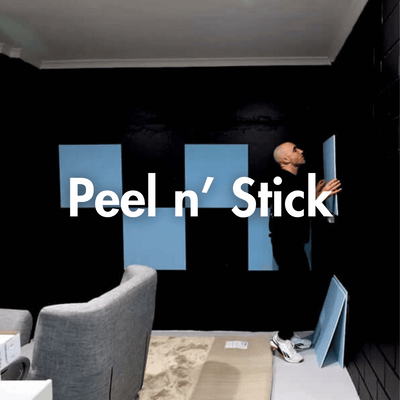
It is a comfort measure, not an exclusion measure. If you have already dealt with the envelope and the room still feels harsh and echoey, that part is treatable, and our peel and stick acoustic tiles are the simplest way to do it without a trade. If the envelope has not been dealt with, treatment will disappoint you.

Where road noise actually gets into a building
Before spending anything, work out where the sound is entering. The South Australian Department for Infrastructure and Transport makes a point that is easy to miss: rather than spending heavily on one item, it is usually more effective to spend a little less across a range of treatments, because sound will simply use whichever path you left open.
The table below is the audit. Work through it for the road-facing side of the building.
| Entry point | Why it leaks | What to do |
|---|---|---|
| Windows and doors | Thin glass, worn perimeter seals, hollow core doors, gaps at the threshold | Fit acoustic seals, upgrade glazing thickness, replace hollow doors with solid core |
| Wall vents and wall-mounted air conditioners | A direct, permanently open air path straight through the wall | Replace with an acoustic vent, hood the existing vent, or move to a split system |
| Roof space and ceilings | Lightweight ceilings with no insulation above them offer very little mass | Add ceiling insulation, or a second layer of plasterboard beneath the existing ceiling |
| Chimneys | Open directly to outside, bypassing the roof and ceiling entirely | Fit a damper at the top, or seal permanently if the chimney is disused |
| Cracked masonry and damaged linings | Cracks that pass fully through the wall create a direct air path | Seal through-cracks and repair damaged plasterboard on lightweight walls |
| Service penetrations | Holes cut for pipes, conduits and cabling are rarely sealed airtight | Seal airtight with a suitable non-hardening filler |
| Gaps in fences and gates | A barrier with gaps in it stops behaving like a barrier | Close gaps between panels, overlap gate ends, seal under gates |
The pattern worth noticing is that most of these are air paths rather than material problems. Sound follows air. If air can move through an opening, so can noise, and a small unsealed gap will undo the performance of the wall or window around it.
That is not a marginal effect. Acoustic consultancy SLR Consulting gives a worked example of a wall assembly rated STC 50 that drops to around STC 22 because of gaps at the floor and ceiling junctions representing less than one percent of the wall area. The lesson transfers directly: sealing is not the finishing touch, it is the first job.
What actually reduces road noise
Work through these in order. The sequence matters, because sealing gaps is cheap and there is little point upgrading glazing while the wall vent beside it is still open.
1. Seal the gaps first
This is the highest return per dollar in the whole list.
Fit acoustic seals to the perimeter of windows and external doors on the exposed façade. Rubber seals perform best. Brush seals fitted with a vinyl fin down the middle outperform plain brush seals. The seal needs to make contact with both the frame and the sash when closed, and a tighter seal gives better reduction provided the window still closes properly.
Doors need attention at the threshold as well as the perimeter, since the bottom seal takes the most wear and fails first. Where a road-facing door is hollow core, replacing it with a solid core door at least 38mm thick is a meaningful upgrade.
Then seal every penetration. Holes cut for pipes, conduits and cabling should be sealed airtight with a suitable filler, and through-cracks in masonry repaired. Superficial cracks that do not pass fully through a masonry wall generally do not need treatment.

2. Upgrade the glazing on the exposed façade
Windows are almost always the weakest element in a façade. Most standard windows use 3mm glass, and thicker glazing reduces low frequency road noise because of its greater density.
The table below gives approximate internal noise reductions for different window systems, measured against a sealed window with 3mm glass. The figures are from the South Australian Department for Infrastructure and Transport homeowner guidance, and all operable window systems shown assume acoustic seals around the perimeter.
| System | Configuration | Approximate reduction |
|---|---|---|
| Single glazing | 5mm sealed glazing | 4 dB(A) |
| Single glazing | Operable window, 10mm glazing | 9 dB(A) |
| Secondary glazing | 3mm + 6mm at 50mm air gap | 7 dB(A) |
| Secondary glazing | 5mm + 10mm at 50mm air gap | 12 dB(A) |
| Double glazing | 10mm + 6mm at 50mm air gap | 14 dB(A) |
| Double glazing | 10mm + 6mm at 100mm air gap | 17 dB(A) |
Two things stand out. Air gap width matters as much as glass thickness, since the same 10mm and 6mm pairing gains 3 dB simply by widening the cavity from 50mm to 100mm. And panes of two different thicknesses outperform matched pairs, because identical panes share a resonance.
Where existing windows cannot take acoustic seals, secondary glazing is the retrofit answer. It fits inside the existing window without modifying it, and it should be installed with a minimum 75mm air gap and its own acoustic seals. Note that double glazing optimised for thermal performance is not the same specification as double glazing optimised for noise, so ask which one you are being quoted.

3. Add mass to light walls and ceilings
Blocking sound requires mass, and this is where construction type decides how much work you have ahead of you.
The same government guidance rates a double brick wall at Rw + Ctr 48 and a brick veneer wall with cavity insulation at 49. A lightweight fibre cement wall with cavity insulation and a single sheet of 10mm plasterboard inside rates 31. Upgrading that internal lining to two sheets of 13mm sound-rated plasterboard takes the same wall to 45, which shows how much of the performance sits in the lining rather than the cladding.
Ceilings are the commonly forgotten surface, particularly in single-storey buildings where the roof space sits directly above the room. Two options work. Adding a second layer of 10mm or 13mm fire-rated plasterboard directly beneath the existing ceiling increases mass, though the ceiling support system needs to be able to carry the extra weight. Alternatively, laying ceiling insulation at least 100mm thick with a minimum density of 14 kg/m³ across the ceiling area will help, and thicker performs better.
One safety note that matters. Insulation laid over downlights is a fire risk. Maintain the required clearance around each fitting or install rated downlight guards.
4. Fix ventilation so windows can stay shut
This is the step that gets skipped, and it undoes everything above it. Sealed, upgraded windows only help while they are closed, and a room with no other source of fresh air will have them open again by the first warm week.
If every window and door in a room faces the road, the room needs an alternative ventilation path. Options include acoustic wall vents, which are passive ventilators designed to admit air while limiting noise, roof space ventilators paired with closable ceiling registers, ducted reverse cycle air conditioning, or evaporative cooling with a breeze path routed through the ceiling rather than an open window.
Existing wall vents on a noisy façade should be replaced with an acoustic vent, fitted with an external hood lined with acoustic insulation, or removed and the opening repaired. Wall-mounted air conditioners cut straight through the wall and are best replaced with a split system.
5. Break the line of sight with a solid barrier
A fence reduces noise only if it blocks the line of sight between the noise source and the building. If you can see the traffic, you can hear it.
Height is set by what you need to block. Blocking sight of car engines is one height, blocking sight of the top of a truck is considerably more. Length matters too, and government guidance suggests a barrier should extend down side boundaries or provide at least 160 degrees of protection to be effective.
Material matters less than continuity. Masonry and stone walls are acoustically effective at any height. Sheet steel works to about 2.4 metres. Timber works provided there are no gaps or cracks within or between panels, and denser, thicker panels perform better. Gates need the same height and material as the fence, with no gaps underneath or at the sides, which usually means overlapping sections or fitted seals.
Check with your planning authority before building, since fence height often needs approval.

What a realistic result looks like
Nobody retrofits an existing building into silence, and any supplier promising that is selling you something.
What is achievable is a layered reduction. Sealing gaps costs little and often produces the most surprising single improvement, because it removes the paths that were bypassing everything else. Glazing upgrades on the exposed façade add the largest measured gains. Ceiling and wall work matters most in lightweight construction. Ventilation is what allows the rest of it to keep working through summer.
Set expectations against the perception scale. A 10 dB improvement, which a considered glazing upgrade can approach, is heard as roughly half as loud. That is a substantial change in liveability without being silence.
If the noise is severe, or the building is commercial and the outcome has to be demonstrated rather than hoped for, engage an acoustic consultant before spending. They will measure what is actually arriving, identify which paths dominate, and tell you where your budget will do the most work. For a significant investment, that advice usually pays for itself.
Frequently asked questions
Do acoustic panels block outside noise?
No. Acoustic panels absorb sound reflecting around inside a room. They do not block sound transmitting into the room from outside. They can make a noisy room feel less harsh by reducing reverberation, but they will not reduce how much traffic noise enters through the windows, walls or ceiling.
What is the cheapest way to reduce road noise?
Sealing gaps. Acoustic seals on the perimeter of road-facing windows and doors, a proper seal at door thresholds, and airtight filling of any holes cut for pipes or conduits. It is inexpensive, it is often achievable without a trade, and because sound follows air paths it frequently produces a bigger improvement than far more expensive work.
Does double glazing stop traffic noise completely?
No, but it is the largest single gain available on most façades. Depending on configuration, double glazing can reduce internal traffic noise by roughly 14 to 17 dB(A) relative to a sealed 3mm single glazed window. Specify two different pane thicknesses and the widest air gap you can accommodate, and be aware that double glazing optimised for thermal performance is a different specification from double glazing optimised for noise.
Do curtains help with road noise?
Only marginally, and not in the way most people expect. Heavy curtains absorb some reflected sound inside the room and can soften the sharpness of what you hear, but they add almost no mass and no airtightness at the window, so they do not reduce how much noise enters. Treat them as a comfort measure, not a noise barrier.
Does a fence reduce road noise inside the house?
It can, provided it breaks the line of sight between the traffic and the building and has no gaps. A solid masonry wall performs at any height, sheet steel works to about 2.4 metres, and timber works if there are no gaps between panels. Gates are the usual weak point, so they need the same height and material with the edges overlapped or sealed.
Can I reduce road noise in a rented home or leased office?
Yes, though your options are the reversible ones. Removable acoustic seals and draught seals on windows and doors, magnetically fixed secondary glazing panels that lift out, and closing or hooding wall vents where permitted all help and can be undone at the end of the lease. Anything involving new glazing, ceiling layers or structural work needs the owner's agreement.
Where to from here
Acoustic Sound Products supplies acoustic treatment, which means products that improve how a space sounds from the inside. We do not supply soundproofing, and if your problem is noise entering from outside, the steps above are the honest answer rather than anything in our range.
Where we can help is the other half of the problem. If traffic noise is getting in and the room then amplifies it, hard floors, bare plasterboard and large areas of glass all reflecting it back at you, that reverberation is treatable and it makes a real difference to how the space feels to sit in.


