












Acoustic Panels vs. Acoustic Foam: What’s the Difference?

When comparing acoustic panels vs acoustic foam, many people assume they do the same thing which is partially correct.
While both are designed to improve sound within a space, they perform very differently and are suited to different environments. Understanding these differences will help you choose the right solution for your room, whether it's an office, studio, classroom, home or commercial space.
Key Takeaways
-
Acoustic foam is lightweight and designed for basic echo control in small spaces
-
Acoustic panels provide stronger, more consistent sound absorption across a wider frequency range
-
Panels are better suited to offices, classrooms and commercial environments
-
Foam is typically used in studios or temporary setups
-
Most spaces benefit more from properly placed acoustic panels than foam
Quick Answer
If your goal is to make a room sound calmer, clearer and more comfortable, both can help. In many cases, improving sound absorption will also reduce how much noise carries to nearby spaces.
-
Acoustic foam is mainly used to absorb reflections inside a room, especially in the mid to high frequencies, which is why it’s often used in studios, podcast rooms and similar setups.
-
Acoustic panels are also used to control echo and reverberation, but they’re usually better suited to everyday commercial and residential interiors because they’re available in more decorative, durable and design-friendly formats.
Acoustic Panels vs Acoustic Foam at a Glance
|
Feature |
Acoustic Foam |
Acoustic Panels |
|
Primary use |
Basic echo control |
Overall sound absorption and noise control |
|
Performance |
Mainly mid to high frequencies |
Broad frequency absorption |
|
Typical spaces |
Studios, small rooms |
Offices, classrooms, commercial and residential spaces |
|
Appearance |
Functional, exposed foam |
Designed finishes that integrate into interiors |
|
Coverage efficiency |
Requires more visible coverage |
More effective with less coverage |
|
Durability |
Can degrade over time |
Long-lasting, commercial-grade materials |
What Is Acoustic Foam?
Acoustic foam is a lightweight material typically shaped into wedges or pyramids. It's designed to absorb reflected sound and reduce sharp echo within a room.
It's most commonly used in:
-
small recording setups
-
podcast or streaming rooms
-
temporary acoustic treatment
Foam works by increasing surface area to break up reflections. While this can improve clarity in small spaces, its performance is generally limited, particularly in larger or more reflective environments.
What Are Acoustic Panels?
Acoustic panels are sound-absorbing products used to reduce echo and reverberation inside a room. They are designed to improve how a space sounds by limiting the amount of noise that bounces off hard surfaces.
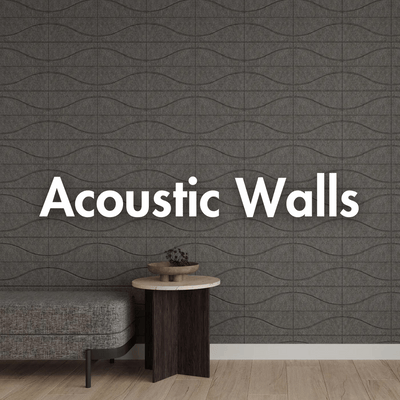
There are different types of acoustic panels depending on where they are to be installed. For example, acoustic wall panels can be used to treat large reflective wall areas, while acoustic ceiling panels are often a good option in open spaces where wall space is limited. In spaces that need a simple DIY-friendly solution, Peel n Stick acoustic tiles can be an easy way to improve acoustics without major installation work.
Acoustic panels are widely used in:
-
offices and meeting rooms
-
classrooms and education environments
-
hospitality venues
-
Music rooms and recording studios
- open plan and shared spaces
Acoustic panels help control internal noise. They can make a significant difference to how comfortable and usable a room feels.
Which One Should You Use?
Use acoustic foam if:
-
the space is very small
-
the goal is basic echo reduction
-
the setup is temporary
-
appearance is not a priority
Use acoustic panels if:
-
you want to improve speech clarity
-
the space is an office, classroom or commercial environment
-
you need consistent and reliable performance
-
design and finish are important
In most cases, acoustic panels are the more effective solution. They provide better results with less coverage and are designed for the types of environments where noise becomes a practical issue.
Do Acoustic Panels or Acoustic Foam Soundproof a Room?
This is one of the most common misunderstandings.
Acoustic foam and acoustic panels are designed for sound absorption. This means they improve how sound behaves within a room by reducing echo and reverberation.
In many environments, especially classrooms and offices, this can significantly reduce overall noise levels and help limit how much sound carries into neighbouring spaces.
However, soundproofing refers to preventing sound from entering or leaving a space. This typically requires structural solutions such as wall systems, insulation, glazing and sealing.
If you are unsure about the difference, our guide to sound absorption vs soundproofing explains why reducing echo inside a room isn’t the same as completely blocking noise transfer.
How to Choose the Right Acoustic Solution
Choosing between foam and panels becomes clearer once the space and goal are defined.
Consider:
-
the size of the room
-
the type of noise
-
how the space is used
-
whether appearance matters
If the goal is to create a comfortable environment where people can communicate clearly, acoustic panels are usually the right choice.
Final Takeaways
-
Acoustic foam is suited to small, controlled environments
-
Acoustic panels provide stronger and more consistent sound absorption
-
Panels are better for offices, classrooms and commercial spaces
-
Reducing sound within a room can help limit noise transfer to adjacent areas
-
Most environments benefit more from acoustic panels than foam
📞 Need help choosing the right option for your space?
Get in touch and we’ll help you choose the right product type, placement and coverage for your environment: