








Acoustic Panels for Offices: A Brisbane Clinic Fitout

Connect Hearing is a national network of hearing clinics, part of the Sonova group, with sites across the country. Their Brisbane office had the problem most offices have. Hard surfaces, open working areas, and speech carrying further than anyone wanted.
We supplied and installed twelve Autex Mirage Textured Panels, 2400 mm x 1200 mm, in the Rammed Earth design and Flatiron colourway, direct fixed across several rooms in the office.
This is that project, followed by what we would tell anyone researching acoustic panels for offices: why offices get loud, where panels go, and how to choose one that looks like part of the fitout.
The project: Connect Hearing, Brisbane
There is a particular reason acoustics matter here. Connect Hearing exists to help people hear clearly, and a reverberant room works directly against that. Following conversation in a hard, echoey space is harder for everyone, and considerably harder for anyone with hearing loss. Treating the office was fitness for purpose, not decoration.
The brief had two halves that usually pull against each other. The space needed to sound better, with reverberation brought under control so conversation stayed clear. It also needed to look deliberate, in a client-facing clinic where a wall of plain acoustic foam would have been the wrong note.
| Project detail | Specification |
|---|---|
| Client | Connect Hearing, Brisbane |
| Product | Autex Mirage Textured Panel |
| Design and colour | Rammed Earth in Flatiron |
| Panel size | 2400 mm x 1200 mm |
| Quantity | 12 panels |
| Absorption | NRC 0.45 to 0.80 |
| Application | Walls across several rooms, direct fix |
| Scope | Supplied and installed by Acoustic Sound Products |

Why a textured panel rather than a plain one
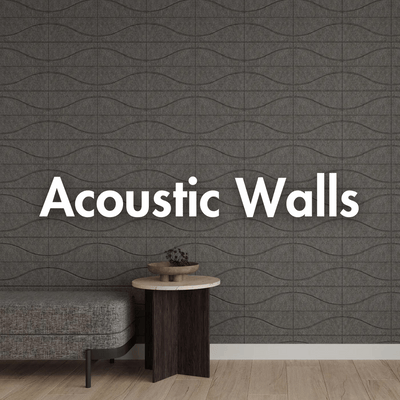
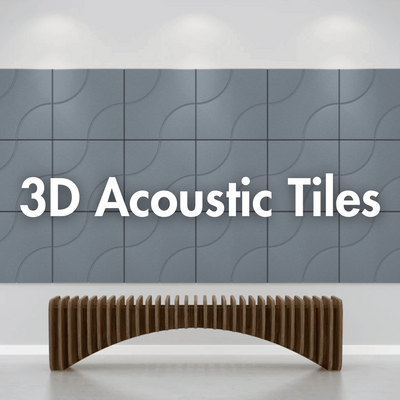
Mirage is a design-led panel. The face is textured into one of six patterns, so it does acoustic work while reading as a considered wall finish rather than treatment bolted on afterwards.
That is what made it right for a clinic. In a warehouse nobody minds how absorption looks. In a client-facing healthcare space the walls are part of the first impression, so Mirage lets the acoustic surface double as the design feature. One decision solves two problems instead of trading one against the other.
Rammed Earth in Flatiron
Mirage designs and colours are specified independently, so any of the six textures can be ordered in any colour in the range. That matters, because it means the panel can be tuned to the space rather than chosen from a handful of fixed looks.
Here the Rammed Earth design was paired with Flatiron. Rammed Earth is a pattern of layered, compressed horizontal bands that reference compacted earth, and Flatiron is a cool, neutral mid-grey. The combination gives each wall texture and depth without colour drawing attention to itself, which suited a calm clinical setting. The swatch is that exact pairing, shot as material.

Treatment spread across the rooms that needed it
Rather than concentrate the panels in one spot, the twelve were distributed across several rooms, placed where each space generated or gathered noise. That is the right approach in a clinic, where the problem is not one large reverberant hall but a set of separate working and consultation rooms that each need to hold clear conversation.
In every room the same principle applied: enough absorption to control reverberation, positioned on the walls that mattered, with the texture doing double duty as the finish.
Why offices get loud
Offices are built from materials that reflect sound. Plasterboard, glass, hard flooring, desks, screens. Very little of a modern fitout absorbs anything.
When someone speaks, that sound reflects off every hard surface and keeps travelling after they stop. That lingering energy is reverberation. It smears speech, so each syllable overlaps the tail of the one before it, and it raises the background level of the room even when nobody is being loud.
Then the feedback loop starts. People raise their voices to be understood over the accumulated noise, which generates more reflected energy again. The room climbs through the working day, which is why an office can feel fine at nine and exhausting by three. Absorption is the only thing that breaks that loop.
Where acoustic panels go in an office
Placement matters more in an office than in a hall, because offices have identifiable noise sources rather than one large reverberant volume.
Near the sound, not on the far wall. The most common retrofit mistake is running panels along whichever perimeter wall was free, well away from where the noise is generated. Absorption works hardest closest to the source, so treat the walls around meeting areas, reception and busy desk clusters first.
On parallel walls. Sound bouncing between two facing hard walls creates flutter, the fast metallic repeat you hear if you clap in a corridor. Treating one of the two surfaces interrupts it.
At speaking height. Panels do the most work roughly one to two metres off the floor, where voices travel, rather than near the ceiling line where the wall is empty and easy to cover.
In rooms where conversations happen. Meeting and consultation rooms benefit disproportionately, because reverberation in a small hard room degrades speech clarity fast. Spreading treatment across each of those rooms, as we did at Connect Hearing, beats loading it all into one.
How to choose a panel for an office
Understand the absorption rating before you buy
Noise Reduction Coefficient runs from 0 to 1 and describes how much sound energy a material absorbs rather than reflects.
Autex Mirage is rated NRC 0.45 to 0.80, depending on the panel thickness and how it is mounted. That is solid mid-range absorption from a wall-mounted panel, and enough to bring a typical office or clinic under control when the coverage is right.
If a room is severely reverberant, has a very high ceiling, or is a hall rather than an office, you may need more than a wall panel delivers. That is a job for a thicker product such as Quietspace Acoustic Panels, rated NRC 0.85 to 1.00.
Check the fire rating
Any product covering a large area of wall becomes part of the building's lining and falls under the National Construction Code's fire hazard requirements. Mirage is tested to AS 5637.1 and AS ISO 9705-2003 and achieves Group 1, the highest classification, with a smoke growth rate index below 100 m²/s². Confirm the rating of any panel before specifying it commercially.
Decide whether the panel is also a design element
This is the choice that separates products. A plain panel does acoustic work and nothing else, which is fine where it will not be seen. A textured panel like Mirage does the same work while functioning as a finished design surface, which is what you want on any wall people look at. Mirage is made from a minimum of 80% recycled PET, comes in six designs and the full Cube colour range, and is made in Australia.

What acoustic panels will not do
Absorption and sound isolation are different jobs, and the distinction matters in any office.
Panels absorb sound energy inside a room. They shorten reverberation, improve speech clarity and reduce how far a voice carries across the floor. They do not stop sound passing through a wall. If the requirement is that a conversation in a closed room cannot be heard from the corridor, that involves wall mass, seals, door specification and ceiling penetrations rather than surface treatment.
If the office is tiring and hard to hold a conversation in, panels are the answer. If you can hear a private appointment from outside the room, that is a different scope of work.
Frequently asked questions
How many acoustic panels does an office need?
It depends on the room's volume, its surface materials and where the noise is generated. The Brisbane clinic took twelve 2400 mm x 1200 mm panels spread across several rooms, but a single carpeted room of the same footprint would need less. The reliable answer comes from assessing the actual space rather than copying a panel count from a similar one.
Can I choose any colour with any Mirage design?
Yes. Mirage designs and colours are specified independently, so any of the six textures can be ordered in any colour in the Cube range. The Connect Hearing rooms paired the Rammed Earth design with Flatiron, but the same texture is available in every other colour if a space calls for it.
Are textured acoustic panels worth it over plain ones?
On any wall that will be seen, yes. A textured panel does the same acoustic work as a plain one while also serving as the design feature, so a single surface solves both problems. On walls that are hidden or purely functional, a plain panel is the more economical choice.
Will acoustic panels make a consultation room private?
No. They improve how a room sounds from inside and reduce reverberation, but speech privacy depends on the mass and sealing of the walls, door and ceiling. Treat privacy and acoustic comfort as two separate requirements.
Talk to us about your office
Getting an office right comes down to three decisions in order: enough absorption for each room, positioned where the noise actually is, and a product that meets the fire requirements while looking like part of the fitout.
Mirage is Group 1 fire rated, rated NRC 0.45 to 0.80, and available in six textured designs across the full colour range in both 2400 mm and 2700 mm panel sizes. We supply and install across Australia, and can send physical samples so you are choosing from material rather than a screen.
View Autex Mirage Textured Panels, designs and colours
If your space needs higher absorption than a wall panel delivers, start with Quietspace Acoustic Panels instead.


